AUTOICON LABORATORIES

DIVISION OF HUMAN CONTINUITY

PROGRAM JOURNEY 1
ACCESS CLASSIFICATION PUBLIC ARCHIVE
SYSTEM STATUS TRANSMISSION ACTIVE

AUTOICON LABORATORIES / ARCHIVAL CARRIER J1

TRANSMISSION CONTAINS AUDIO SELECT AUDIO TO LISTEN
AUTOICON LABORATORIES
PROGRAM 01

FIELD MANUAL

JOURNEY 1 / ARCHIVE OF LIVING IN THE 21ST CENTURY PROGRAM REFERENCE / 01 DIVISION OF HUMAN CONTINUITY

A continually expanding archive of first-person testimony recorded for people living one thousand years in the future.

SECTION 01

OBJECTIVE

Journey 1 preserves first-person testimony for audiences one thousand years in the future. Participants describe where they live, what they do, how they spend their time, and the technologies present in their daily lives.

The archive is not curated as a representative portrait of humanity. Participation remains open, and each record is maintained without ranking by geography, profession, social position, or historical importance.

SECTION 02

JOURNEY 1

Journey 1 is the first field program of AutoIcon Laboratories. Its initial deployment took place at KVANTUM Festival in Podhradie, Slovakia, from 19 to 21 June 2026. Thirty-four participants entered the field recording station and recorded individual transmissions.

Line drawing of the complete closed Journey 1 archive vessel
FIGURE 01JOURNEY 1 ARCHIVE VESSELEXTERIOR ASSEMBLY / CLOSED CONFIGURATION
SECTION 03

ARCHIVE VESSEL

The Journey 1 preservation system combines a four-sided pyramid cover, a flat archival base, and an internal tooth-form vessel. Together these components create a material counterpart to the public digital archive.

Line drawing of the Journey 1 pyramid cover, internal vessel, and removable cap
FIGURE 02JOURNEY 1 PRESERVATION COMPONENTSPYRAMID COVER / INTERNAL VESSEL / VESSEL CAP
SECTION 04

VESSEL BASE

The internal archive vessel is seated on the flat base before the pyramid cover is placed over the assembly. The base stabilizes the vessel and establishes the physical foundation of the preservation system.

Line drawing of the internal Journey 1 vessel seated on the archival base
FIGURE 03ARCHIVE VESSEL BASEINTERNAL VESSEL / SEATED CONFIGURATION
SECTION 05

PRESERVATION SYSTEM

A human tooth forms the innermost archival carrier. The project proposes encoding the digital archive into synthetic DNA housed within the tooth, which is placed inside the internal vessel and protected by the complete assembly.

Technical exploded-view diagram of the Journey 1 pyramid cover, internal tooth vessel, human tooth, and flat archive base
FIGURE 04ARCHIVE CROSS SECTIONNESTED PRESERVATION ASSEMBLY
SECTION 06

INTERNAL ARCHIVE VESSEL

The tooth-form vessel holds the biological archive and is sealed by a separate cap. Its form links the physical carrier to the human body while distinguishing the archive as a purpose-built preservation object.

Line drawing of the open Journey 1 internal archive vessel, human tooth, and vessel cap
FIGURE 05INTERNAL ARCHIVE VESSELHUMAN TOOTH / SYNTHETIC DNA CARRIER / REMOVABLE CAP
SECTION 07

COLLECTION PROTOCOL

During recording, each participant temporarily assumes the status of an Auto-Icon: a deliberate act of self-representation produced for an audience outside the participant’s lifetime.

01

The participant enters an AutoIcon Laboratories field recording station.

02

The participant records a two- to three-minute transmission describing aspects of contemporary life.

03

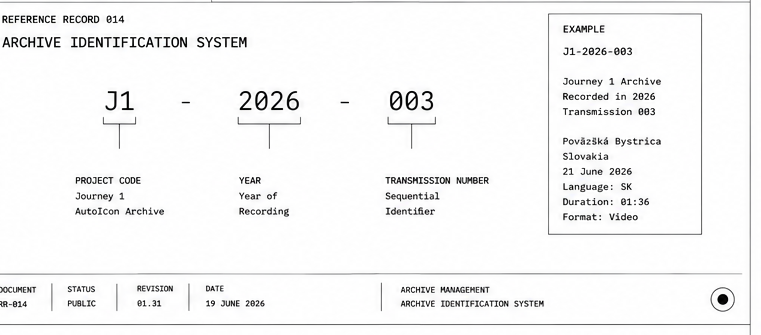
The recording receives a permanent Record Identifier containing its Journey, year, and sequence number.

04

The record enters the public archive as an independent testimony.

SECTION 08

NONHIERARCHICAL ACCESS

Records are presented through a randomized retrieval sequence. Each visit generates a new order, and every available testimony is played once before the sequence is reshuffled. No record is prioritized over another.

SECTION 09

ARCHIVE LINEAGE

The term Auto-Icon originates with philosopher Jeremy Bentham, whose preserved body was intended to continue representing him after death. Donald Rodney later transferred the proposition into a digital and networked form. AutoIcon Laboratories extends this lineage through testimony recorded while the contributor is alive.

Line drawing of Jeremy Bentham seated as an Auto-Icon
FIGURE 06HISTORICAL REFERENCEJEREMY BENTHAM'S AUTO-ICON
SECTION 10

FIELD DEPLOYMENTS

The archive expands through temporary recording stations established in new locations. Only completed deployments containing accessioned records are represented.

World map showing the initial Journey 1 field deployment in Slovakia
DEPLOYMENT 001 KVANTUM FESTIVAL PODHRADIE, SLOVAKIA 19–21 JUNE 2026 34 ACCESSIONED RECORDS
FIGURE 07COMPLETED FIELD DEPLOYMENTSINITIAL DEPLOYMENT / SLOVAKIA

Journey 1 and AutoIcon Laboratories created by

ELIZABETH WITHSTANDLEY

WITHSTANDLEY.COM
INFO@WITHSTANDLEY.COM

Institutional inquiries, exhibitions, and future field deployments

© 2026 Elizabeth Withstandley

DOCUMENT AL-J1 / FIELD MANUAL / REV 68 / INITIAL DEPLOYMENT 19–21 JUNE 2026

AUTOICON LABORATORIES

PARTICIPATE

Journey 1 is open to people who wish to record a description of life in the twenty-first century for audiences one thousand years in the future.

CONTRIBUTION 001

WHO MAY PARTICIPATE

Participation is not selected according to profession, geography, social position, or historical significance. The archive values ordinary experience alongside public events and recognized figures.

CONTRIBUTION 002

WHAT TO DESCRIBE

Recordings focus on your daily life: where you live, what you do, how you spend your time, the technologies you use, and what you think people living 1,000 years from now would want to know about life in the 21st century.

CONTRIBUTION 003

RECORDING PROCESS

Contributions may be submitted as audio, an image, or video. Video transmissions should be two to three minutes long and answer the standard Journey 1 question. After review and permission for public presentation, accepted contributions receive a permanent Record Identifier.

CONTRIBUTION 004

SUBMIT A CONTRIBUTION

Contributions may be submitted through the upload form below or sent by email to info@withstandley.com. You may submit one audio file, image, or video. For video, record yourself answering the standard question in two to three minutes:

Describe where you live, what you do, how you spend your time, and the technologies you use in your daily life.

EMAIL SUBMISSION

Contributions may also be emailed to info@withstandley.com. Please include the recording location, recording date, and language. Audio, image, and video files are accepted.

Questions about field recording stations or institutional deployments may be sent to the same address.

DOCUMENT AL-J1 / PARTICIPATION PROTOCOL / REV 68